
Restoring a 100 year old pen: Valentine Pen
- Brian Callanga
- May 11
- 3 min read

Some pens arrive not just as tools, but as quiet pieces of history. The Valentine Pen was one of those restorations that immediately felt personal the moment it was placed on the bench. I actually found it on Facebook Marketplace, and at first glance I thought it might be a frankenpen because of the difference in colour between the cap and the barrel. The contrast looked too intentional to be natural aging. However, after closer inspection, it became clear that it was not a mismatched build at all. The inside of the cap matched the barrel perfectly, revealing that the difference was simply discoloration over time rather than a mix of parts.

Inside of the barrel

Barrel with the engraving
Pens like the Valentine Pen sit within a broader period of fountain pen history where many smaller manufacturers produced practical, everyday writing instruments. Many of these pens were built around simple, reliable sac filling systems and designed for daily use rather than luxury display. They represent an era where pens were made to be used, repaired, and kept in circulation for as long as possible.
It had clearly been well loved in its time, but like many fountain pens that have been set aside for years, it had begun to lose its voice.
First Impressions
At first glance, the pen showed the typical signs of long-term storage. Dried ink inside the system, a stiff or unresponsive ink flow, and a general lack of smoothness when tested. The exterior still held its charm, but it was clear that internally, the pen needed careful attention before it could write again properly.
One important detail was that this pen uses an ink sac system. This meant the restoration would need to go beyond simple flushing, as the sac itself plays a crucial role in ink delivery and is often one of the most vulnerable components in older pens.
With any restoration, the goal is never to rush. It begins with understanding the condition of the pen as a whole, how it was built, how it has aged, and what it needs to return to writing form without compromising its original character.
Careful Disassembly and Assessment

The Valentine Pen was carefully taken apart to assess each internal component. This step is always done slowly and deliberately, as older pens can be sensitive to pressure and time has a way of affecting materials in subtle ways.
Inside, there was significant ink residue buildup, particularly in the feed system and around the ink sac. This is a common issue in sac-filled fountain pens that have been left unused for long periods, and it often explains inconsistent ink flow or complete failure to start.
Each part was inspected individually, ensuring nothing was forced or damaged during the process. Restoration is as much about patience as it is about skill.
Deep Cleaning and Ink Sac Evaluation

Once disassembled, each component underwent a thorough cleaning process. The feed was flushed repeatedly until all old ink deposits were fully removed. The nib was carefully cleaned and inspected under magnification to ensure proper alignment and smoothness.
The ink sac was also carefully replaced.
This stage is often where a pen begins to “wake up” again. As the layers of dried ink and residue are removed, the original design and function start to reappear.
Reassembly and Nib Tuning
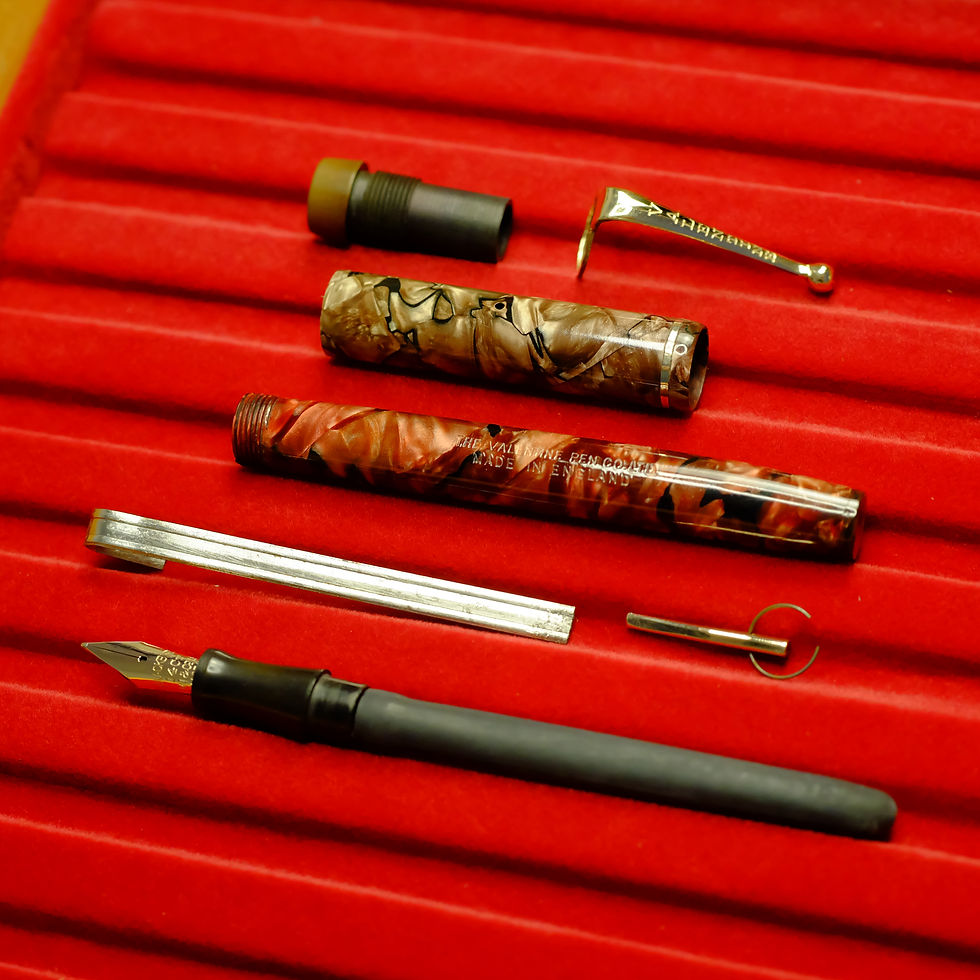
After everything was cleaned and verified, the pen was carefully reassembled. This is a critical stage where alignment matters most. Even slight misalignment can affect ink flow and writing comfort.
The nib was then tuned to restore smoothness and responsiveness. Each adjustment was made gradually, testing along the way to ensure a balanced writing experience that felt natural and controlled.
Final Writing Test
The final step is always the most rewarding. Putting ink back into the pen and testing it on paper.
The Valentine Pen came back to life beautifully. Ink flow was consistent, the nib felt smooth, and the writing experience had regained its intended character. There is always something special about seeing a pen move from hesitation back into confident, flowing script.


Closing Thoughts
Restoring the Valentine Pen was a reminder that fountain pens are not just objects. They are tools of expression that carry memory, emotion, and personal history. With the right care, even a pen that has been silent for years can return to the page and continue its story.
Every restoration is different, but the goal remains the same. Bringing back not just function, but the joy of writing.

Comments